How to analyse your own padel match
Film one set from behind the back glass, then watch it three times for three different things. A practical way to see your own game clearly and choose the one thing to practise next.
On court you watch the ball. You don’t see where you were standing when it came back, how far your partner was from you, or what you did in the second after your best shot. A video of your own match shows all of it, and it has no opinion about how you played.
This guide covers three things: how to film a match so it’s worth watching, how to watch it without drowning in detail, and how to turn what you see into one thing to practise next.
Film it from behind the back glass
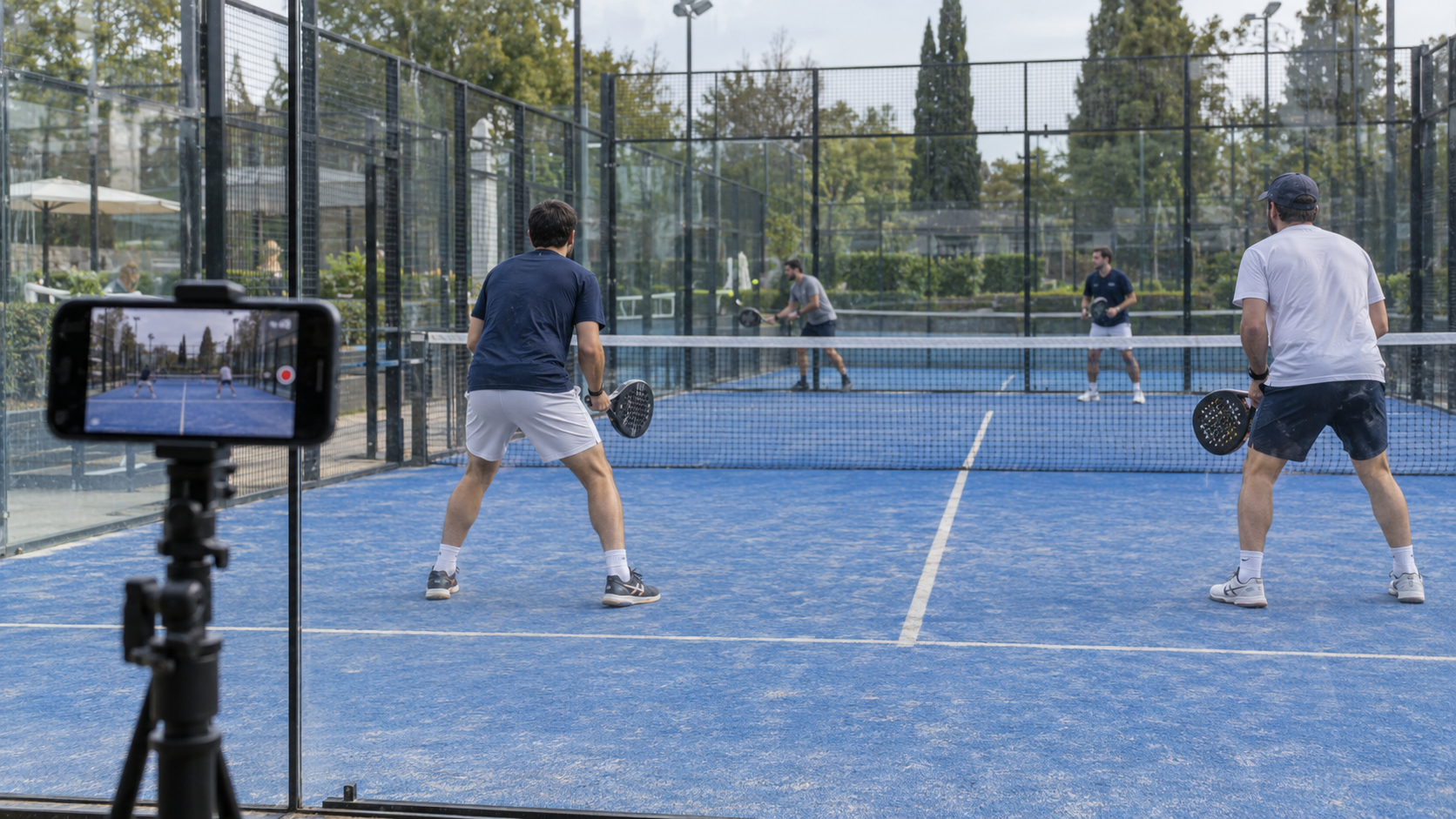
Put your phone outside the back glass, centred behind the court, on a steady mount at about chest height, and turn it landscape. From there one phone sees the whole court: both pairs, the net, and the middle between you and your partner, which you can never see while you play.
Before you press record, check four things:
All four corners and the net are in frame. A point that ends in a corner you cut off is a point you can’t learn from.
The light is clean. Floodlight glare on the glass hides players. Move the phone along the glass until the glare clears.
The phone is steady. A clip-on mount or a small tripod beats a phone propped against a bag.
Everyone knows. Tell the other three players you’re recording. It’s their match too.
Ten minutes of continuous play is enough to learn from. A full set is better, because it gives you more of each situation to compare: more returns, more lobs, more overheads.
Watch it three times, for three different things
Watching everything at once means seeing nothing. Give each viewing one job, and write down what you notice as you go.
First: how each point ends
Watch the ball, as you did on court, and note only how each point finished: a winner, an error, or a ball nobody reached. Don’t judge yet; just keep the tally. After a set, the endings tend to gather in a few places, such as the middle, the backhand corner or the ball after a lob.
Second: where you and your partner stand
Now ignore the ball. Watch the two of you, and pause each time an opponent hits. Are you both at the net, or both back? Is one of you up and the other back? Is the middle closed, or could a ball pass between you? Pairs move up and back together, and a pause at the moment of the opponent’s shot shows whether you do.
On court you watch the ball. On video, watch yourself.
Third: one shot, slowly
Pick the shot that came up most in your notes and watch every one of them at half speed. Look at your body rather than the result: whether you were side-on, where you met the ball, and where you went the moment after you hit it.
Five moments worth pausing on
Whatever your notes say, these moments show a lot in a few seconds of video.
After your overhead. Do you move forward to the net, or stay where you hit it from? Staying back after a bandeja leaves the middle open for the next ball.
When you lob. A high, deep lob is your way back to the net. Did you and your partner move up behind it, or watch it land?
At the net. Between shots, is your racket up and in front of you, or down by your knees?
Off the back glass. Do you give the ball room and let it come out to you, or play it before it has come off the glass?
As the opponent hits. Is there a split step, or are you still moving when the ball leaves their racket?
Turn what you see into one thing to practise
By now you’ll have more than one thing you’d like to change. Pick one: the one that came up most in your notes, not the one that annoyed you most. Trying to fix everything before your next match is how nothing changes.
Then give it three steps:
Learn it. Know what it should look like, in one sentence you can say to yourself on court.
Practise it. Take it into a drill with your partner, where the same situation comes back again and again.
Use it. Take it into your next match, and give yourself one job there: that one thing.
Then film that match too, and watch for the one thing. Record, review, train, repeat: that loop is how a habit you could only feel becomes one you can see changing.
Where Rallix fits
Everything above works with any phone and a notebook. Rallix is built around the same loop, so the watching is done for you. Record from behind the back glass, or import footage you’ve already filmed, and choose up to 15 minutes of play. Rallix reviews it, shows you the moments that matter, and gives you one focus with a lesson, a drill and a mission for your next match. When it can’t see something clearly, it tells you so rather than scoring it.